Table of Contents
ToggleChicken jockeys are one of Minecraft’s most bizarre and dangerous mob combinations, a rare hostile encounter where a baby undead mob rides atop a chicken like a twisted knight on horseback. Unlike regular zombies or husks, chicken jockeys move faster, take no fall damage, and fall slowly, making them surprisingly lethal in the right circumstances. Whether you’re exploring caves at night, defending your base, or experimenting in Creative mode, understanding what chicken jockeys are and how to handle them can mean the difference between surviving and respawning. This guide breaks down everything you need to know about these unusual mobs.
Key Takeaways
- Chicken jockeys spawn when a baby undead mob mounts a chicken, combining faster movement, no fall damage, and slow falling into one unusually dangerous mob combination.
- The probability of a chicken jockey spawning is approximately 0.25% to 0.49% depending on whether chickens are already present in the spawn area.
- Lighting caves, dungeons, and base perimeters thoroughly is the most effective way to prevent chicken jockey spawns since dark areas attract baby undead.
- Combat against chicken jockeys favors ranged weapons like bows and crossbows, with knockback effects being especially valuable for creating distance and repositioning.
- In Creative mode, Java Edition allows instant chicken jockey creation using NBT summon commands, while Bedrock Edition requires workarounds like water currents or structure blocks.
- Chicken jockeys can squeeze through 1-block-high gaps and fall slowly without taking damage, making them uniquely mobile threats compared to standard baby zombies.
What Is a Chicken Jockey?
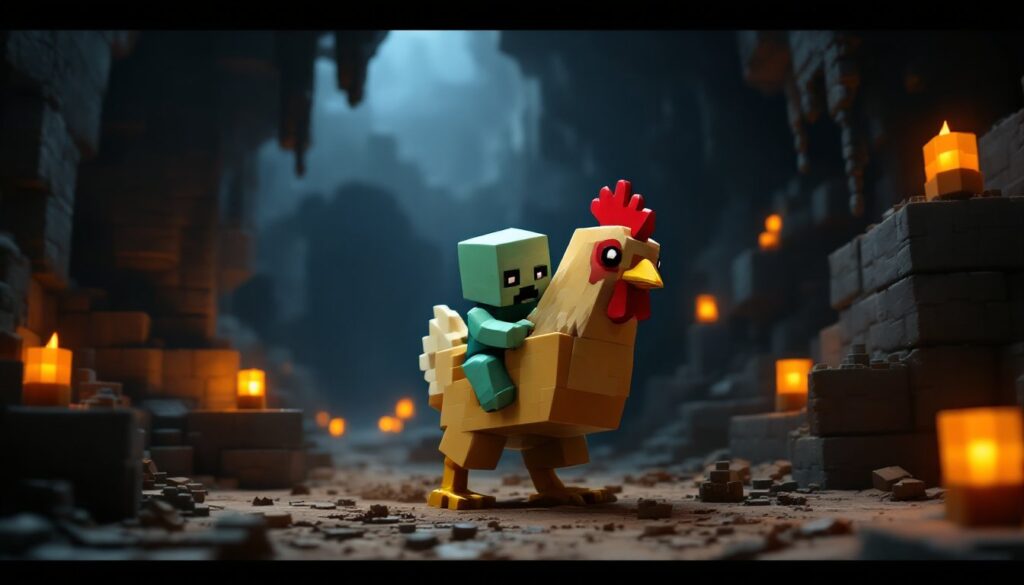
A chicken jockey is a rare hostile mob combination that spawns when a baby undead mob successfully mounts a chicken. The rider can be any of five mob types: a baby zombie, baby zombified piglin, baby zombie villager, baby husk, or baby drowned. The chicken serves as the mount, providing mobility and unique physical properties, the rider controls movement and attacks while the chicken handles speed and physics.
What makes chicken jockeys dangerous is the synergy between rider and mount. The rider deals damage like its normal counterpart (a baby zombie attacks with melee damage), but the chicken underneath provides crucial advantages: significantly faster ground speed than walking zombies, slow falling that prevents fall damage, and the ability to move through tighter spaces. Encountering one in a dark cave or near your base is far more threatening than meeting a lone baby zombie.
How Chicken Jockeys Spawn in Minecraft
Chicken jockey spawning is governed by specific probability checks in both Java and Bedrock editions. The mechanics are similar but vary slightly in exact percentages.
Whenever a baby zombie-type mob spawns naturally in the world, the game runs two sequential checks. First, it looks for a nearby chicken within a 10×6×10 block area around the spawn point. If a chicken is found and meets conditions, there’s a 5% chance the baby will mount it. If that fails (95% chance), there’s a second 5% chance the game spawns a fresh chicken beneath the baby zombie, essentially creating the jockey on the spot.
The math is important here: in a chicken-poor environment, a spawned baby zombie has roughly a 0.25% chance to become a chicken jockey (5% of 5%). With chickens already present nearby, this probability roughly doubles to about 0.4875%. For context, monthly search volume for chicken jockey mechanics sits around 9,100 searches, indicating plenty of players encounter them unexpectedly.
Natural Spawn Conditions and Locations
Chicken jockeys follow the normal spawn rules of their rider type, so understanding where each baby undead spawns is key to predicting jockey encounters.
Baby zombies spawn in dark overworld areas, caves, dungeons, or the surface during nighttime. Baby husks appear in desert biomes during low-light conditions, particularly useful for avoiding them by staying lit. Baby zombie villagers spawn wherever regular zombie villagers appear, typically in dark areas or when a zombie infects a villager. Baby drowned spawn in water and ocean locations, making them a concern near rivers or coastlines. Baby zombified piglins spawn in the Nether where their adult counterparts appear, often on magma blocks, here’s the catch: chickens take damage on magma, so Nether jockeys rarely survive long.
To reduce natural chicken jockey spawns, light up caves and secure your base perimeter. The brighter your area, the lower the spawn rate of baby undead, and hence the lower the chicken jockey chance.
Combat and Defense Strategies
Chicken jockeys demand respect in combat. They’re faster than regular baby zombies and inherit the rider’s attack damage, making them a legitimate threat even to armored players.
The first rule: move quickly. A chicken jockey on flat terrain will catch you if you’re walking casually. Sprint away if unprepared, or engage with distance. Use knockback weapons, Knockback II is especially valuable since the chicken provides no mobility immunity. A good shield bash or crit hit sends them flying, buying time to reposition.
Ranged attacks are your safest bet. Bows and crossbows let you stay out of the chicken’s reach while dealing full damage to the rider. A few arrow shots will drop most baby zombie jockeys before they close distance. Aim for the rider first, it’s the damage source: the chicken is just transport.
Defensively, light up caves and caves systems thoroughly. Dark areas attract baby undead, so maintaining torches and lanterns prevents spawns entirely. Secure your base with perimeter lighting and walls. If you’re caught off-guard, use terrain to your advantage, climb onto blocks the chicken can’t easily reach, or use water to slow their movement while you attack.
Identifying and Engaging Chicken Jockeys
Spotting a chicken jockey is straightforward once you know what to look for. Visually, you’ll see a baby undead (noticeably smaller than adult zombies) riding atop a chicken, moving faster than any chicken would solo. The rider’s model sits on the chicken’s back, making the combination unmistakable.
Behaviorally, chicken jockeys have two tells. First, they fall slowly, dropping from a height, they descend gradually without taking fall damage, unlike regular mobs. Second, they can squeeze through 1-block-high gaps because the chicken fits. But, if an overhead block is solid directly above a 1-block-high space, the rider can suffocate while the chicken passes through. This quirk rarely matters in combat but can trap them in certain terrain layouts.
Engage them like any hostile mob: stay alert, maintain distance if possible, and use ranged weapons or knockback tools to control the fight. They’re not invincible, just faster and slightly more dangerous than their base components.
Creating Chicken Jockeys in Creative Mode
Building chicken jockeys in Creative mode is straightforward on Java Edition and possible but more involved on Bedrock. If you’re experimenting with mob mechanics, custom maps, or testing combat strategies, summoning commands let you spawn them on demand.
Java Edition supports NBT (Named Binary Tag) data in summon commands, making jockey creation simple. The basic command for a baby zombie riding a chicken is:
/summon zombie ~ ~ ~ {IsBaby:1b,Passengers:[{id:"chicken"}]}
Alternatively, you can spawn a chicken first and add passengers:
/summon chicken ~ ~ ~ {Passengers:[{id:"zombie",IsBaby:1b}]}
You can swap “zombie” for “zombie_villager”, “husk”, “drowned”, or “zombified_piglin” to create different jockey types. Adding equipment data, like giving the rider full netherite armor and weapons, is possible by expanding the NBT data, useful for custom challenge maps.
Bedrock Edition lacks direct NBT support in standard commands, so the process requires workarounds. Summon a chicken, then use /summon zombie ~ ~ ~ baby to place a baby zombie nearby. Next, push the baby zombie onto the chicken using water currents, pistons, or other mechanics. Alternatively, use structure blocks to save and load a pre-made jockey, or rely on community behavior packs that enable direct summoning. Some servers and custom maps use these addons for streamlined jockey spawning.
For testing purposes on either edition, spawning a few jockeys and engaging them in a controlled environment (like an arena) lets you understand their behavior and refine your combat strategy.
Conclusion
Chicken jockeys are rare, fast, and unexpectedly dangerous, a blend of baby undead mobility and chicken physics that creates a unique threat in Minecraft. They spawn through low-probability checks whenever baby zombies encounter chickens, or spawn naturally wherever baby undead appear. Understanding their behavior, spawn conditions, and combat weaknesses prepares you for real encounters while exploring, and Creative mode commands let you experiment freely. Whether you’re defensive-minded or just curious about mob mechanics, chicken jockeys deserve respect and a well-planned strategy.