Table of Contents
ToggleOcean monuments are among Minecraft‘s most intimidating structures, and for good reason. The moment you approach one, you’re greeted by laser beams cutting through the water and hostile mobs that don’t stop attacking until you’re dead or they are. Guardians, and their more dangerous cousins, elder guardians, are what stand between you and some of the game’s best building materials.
Whether you’re hunting prismarine for your next megabuild, setting up an XP farm, or just want to conquer every challenge Minecraft throws at you, understanding guardians is non-negotiable. This guide breaks down everything you need to know: where they spawn, how they attack, what they drop, and how to turn their home into a farm that churns out resources while you sleep.
Key Takeaways
- Minecraft guardians are hostile aquatic mobs with laser attacks that spawn exclusively in ocean monuments and drop valuable prismarine materials needed for building.
- Elder guardians are the three permanent mini-bosses per monument that inflict Mining Fatigue III, a debilitating debuff that must be cleared before efficient monument construction can begin.
- Combat success against guardians requires proper preparation: use tridents with Impaling V, full protective armor with Depth Strider III boots, water breathing potions, and tactical cover positioning behind the monument’s structure.
- Guardian farms generate massive resources and XP by utilizing the monument’s spawn mechanics—create dark spawn chambers with water channels that funnel guardians into kill zones for efficient harvesting.
- A powered conduit eliminates most underwater combat penalties by providing Water Breathing, Night Vision, and Haste effects, making monument exploration and farm construction dramatically faster.
- Looting III enchanted weapons are essential for maximizing drops, with optimized farms producing up to 30,000 prismarine shards and 12,000 crystals per hour.
What Is a Guardian in Minecraft?
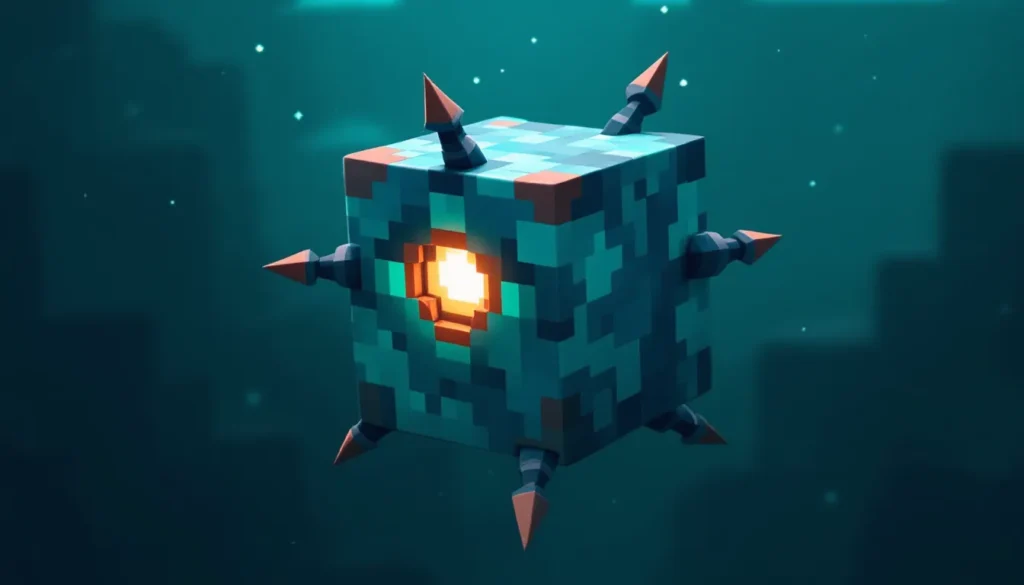
Guardians are hostile aquatic mobs that spawn exclusively in and around ocean monuments. They’re immediately recognizable by their cube-shaped bodies, single eye, and array of spikes that extend when they’re preparing to attack. Guardians deal damage through a laser attack that locks onto players and continues dealing damage as long as line of sight is maintained.
In terms of stats, guardians have 30 health points (15 hearts) and deal 4 to 9 damage depending on difficulty. They’re classified as aquatic mobs, meaning they can breathe underwater indefinitely but will take damage if beached on land. Their movement is erratic, guardians swim in random directions and can navigate vertically with ease, making them unpredictable in combat.
Guardians drop prismarine shards, prismarine crystals, and occasionally raw cod. They also provide 10 XP upon death, making them decent targets for farming once you’ve set up the infrastructure.
Guardian vs. Elder Guardian: Key Differences
While guardians and elder guardians share similar attack mechanics, the differences are significant. Elder guardians are mini-bosses that spawn exactly three times per ocean monument and never respawn once killed. They’re much larger, deal more damage (5 to 12.5 depending on difficulty), and have 80 health points (40 hearts).
The most critical difference is the Mining Fatigue III debuff that elder guardians inflict. This curse applies to any player within a 50-block radius and persists even through walls, making it nearly impossible to mine blocks without clearing the monument first. Elder guardians drop the same items as regular guardians but in higher quantities, plus they always drop one wet sponge, a rare item that can’t be obtained any other way in survival mode.
In short: guardians are the respawning defenders, elder guardians are the monument’s permanent bosses.
Where to Find Guardians in Minecraft
Guardians don’t spawn just anywhere underwater. They’re tied exclusively to ocean monuments, and finding one is the first challenge.
Locating Ocean Monuments
Ocean monuments generate in deep ocean biomes, both regular deep ocean and deep frozen ocean variants. They’re massive prismarine structures that sit on the ocean floor, usually at Y-level 40 or lower. The monuments are rare, so you’ll likely need to explore for a while unless you use a few tricks.
The most efficient method is using an explorer map, which you can buy from cartographer villagers. Trade paper and emeralds to level up a cartographer, and eventually they’ll sell you an ocean explorer map that marks the nearest monument’s location. Alternatively, if you’re comfortable using console commands, /locate structure minecraft:monument will give you coordinates instantly in creative mode or with cheats enabled.
Visually, ocean monuments are hard to miss once you’re close. They’re constructed entirely of prismarine blocks and emit a teal glow from sea lanterns. If you see guardians swimming in open water, you’re near one.
Spawn Conditions and Requirements
Guardians spawn naturally inside the bounding box of ocean monuments, which extends slightly beyond the structure’s visible walls. They can spawn in any water block within this area, regardless of light level. The spawn rate is capped, monuments can hold a maximum of around 80 guardians at once, and they spawn continuously to maintain population.
Crucially, guardians do not spawn in bubble columns, and they can’t spawn if the water block is occupied by another mob or entity. This becomes relevant when you’re designing farms, as draining or modifying the monument affects spawn mechanics.
Once the three minecraft elder guardian mobs are killed, they won’t return, but regular guardians will keep spawning as long as the monument’s bounding box remains intact and filled with water.
Guardian Behavior and Attack Patterns
Understanding how guardians fight is half the battle. They’re not mindless, they adapt to distance and react to your movements.
Laser Attack Mechanics
The laser attack is the guardian’s primary weapon. Once a guardian targets you, its eye locks on and a purple beam extends from its body to yours. The beam takes about 2 seconds to charge (indicated by the beam growing brighter), after which it deals damage every half-second until the beam is broken.
Damage ranges from 4 on Easy to 9 on Hard per hit, and because it ticks twice per second, you can lose health fast if caught in the open. The laser requires unobstructed line of sight, ducking behind a pillar or block breaks the beam and forces the guardian to retarget.
One often-overlooked detail: the laser doesn’t ignore armor. Protection enchantments and armor reduce the damage, making tanking viable with the right setup.
Movement and Swimming Behavior
Guardians don’t pathfind like land mobs. They swim in random directions, occasionally drifting upward or downward, which makes predicting their movement difficult. When aggroed, they don’t charge at you, they maintain distance and attack from range.
This creates a chase dynamic where you’re the one closing distance while dodging lasers. Guardians also have a spike animation that plays when their health is full and they’re not attacking. The spikes retract once they begin charging a laser or take damage. It’s cosmetic, but it’s a good visual cue for when they’re idle versus hostile.
On land, guardians are helpless. They flop around like fish and take suffocation damage, dying within seconds. Use this to your advantage when luring them out of water.
How to Defeat Guardians: Combat Strategies
Fighting guardians isn’t like fighting zombies. You’re in their element, and they don’t give you time to breathe, literally.
Best Weapons and Enchantments
For melee, a diamond or netherite sword with Sharpness V is standard. But, the real MVP is the trident with Impaling V. Impaling deals massive bonus damage to aquatic mobs, and since guardians count, you’re looking at over 20 damage per hit on a fully charged throw. Tridents also let you attack from range, which is critical for avoiding sustained laser damage.
If you’re using a sword, you’ll need to close distance fast. Guardians have a tendency to drift away while charging their laser, so sprint-swimming with depth strider boots helps you land hits before they fire.
For ranged backup, a bow or crossbow works, but underwater arrows lose velocity and deal reduced damage. It’s better to rely on the trident unless you’re fighting from the surface.
Armor and Potions for Underwater Combat
Full netherite armor with Protection IV is ideal, but even diamond works if you’re early-game. The key enchantment is Respiration III on your helmet, which extends underwater breathing time and pairs well with an Aqua Affinity helmet for faster block breaking if you need to dig.
Boots should have Depth Strider III to move at normal speed underwater. Without it, you’re sluggish and vulnerable.
For potions, Water Breathing is mandatory unless you’re using a conduit. A single extended potion lasts 8 minutes, giving you plenty of time to fight. Night Vision potions make underwater combat dramatically easier by removing the murky visibility, especially in deep ocean trenches. Regeneration or Healing potions can clutch out close fights when lasers pile on.
Tactical Positioning and Cover
The monument’s structure is your ally. Guardians need line of sight to laser you, so use pillars, walls, and doorways to break the beam. Fight in short bursts: peek out, land a hit or two, retreat behind cover as the laser charges.
If you’re overwhelmed, retreat to a dry room inside the monument, guardians won’t follow you out of water. You can also create air pockets using doors or trapdoors to catch your breath and heal.
Never fight guardians in open water if you can avoid it. The community modding scene has even developed tools to help players visualize spawn areas, but in vanilla Minecraft, sticking close to the monument’s geometry keeps you alive.
Guardian Drops and Loot
Guardians aren’t just obstacles, they’re resource nodes once you know what to farm.
Prismarine Shards and Crystals
Every guardian drops 0–2 prismarine shards, with the average sitting around 1 per kill. These are essential for crafting prismarine blocks, which come in three variants: regular prismarine, prismarine bricks, and dark prismarine. Each requires shards as the base ingredient.
Prismarine crystals are rarer, dropping 0–1 per guardian with about a 40% drop rate. Crystals are used to craft sea lanterns (combine with shards) and are harder to stockpile, making them the bottleneck for large-scale building projects.
The Looting enchantment increases both drop rates, with Looting III giving you up to 5 shards and 2 crystals per kill. If you’re farming manually, Looting is non-negotiable.
Raw Cod and Other Items
Guardians have a 40% chance to drop raw cod, which is mostly useless given how common fish are elsewhere. But, if you’re running a guardian farm, cod stacks up as a side benefit, cook it for food or trade it to fisherman villagers.
Guardians don’t drop rare items like tridents or nautilus shells. Those are exclusive to drowned mobs. The real value is in the prismarine materials and the 10 XP per kill, which adds up fast in automated farms.
Building a Guardian Farm: Step-by-Step Guide
Once you’ve cleared a monument, the next move is turning it into a farm. Guardian farms are among the best XP and resource generators in the game.
Preparing the Ocean Monument
First, kill all three minecraft elder guardian mobs. They won’t respawn, and Mining Fatigue makes construction impossible. Once they’re dead, the debuff is gone permanently.
Next, decide whether to drain the monument or work underwater. Draining is easier for large-scale construction but requires massive sponge farms or sand/gravel. If you have the three wet sponges from the elder guardians plus extras from monument sponge rooms, you can start a sponge drying cycle in a furnace and gradually clear sections.
Alternatively, use a conduit. Place a conduit in the center of the monument surrounded by a frame of prismarine or sea lanterns. A fully powered conduit gives you Water Breathing, Night Vision, and Haste in a 96-block radius, making underwater work almost as fast as building on land. Many players consider detailed build guides essential when planning complex redstone-based farms like this.
Farm Design and Mechanics
The most common design is a spawning platform farm. Guardians spawn within the monument’s bounding box, so you create dark spawn chambers where guardians appear, then use water channels to flush them into a kill chamber.
Here’s the basic process:
- Identify the bounding box using F3+G (Java Edition) or third-party tools.
- Build spawn platforms at multiple Y-levels within the box, spaced to maximize spawn surface area.
- Create water streams that push guardians toward a central collection point.
- Design a kill chamber where guardians are damaged to low health (using fall damage or entity cramming) and finished by the player for XP, or killed automatically for AFK farming.
Some farms use magma blocks at the bottom of drop chutes to kill guardians automatically, though this sacrifices XP. For manual farms, leave guardians at 1–2 hearts and one-shot them with a Looting sword.
Maximizing XP and Drop Rates
The key to efficiency is spawn rate optimization. Guardians spawn slower if the area is cluttered with mobs, so kill them quickly. Use a trident with Loyalty to pull them in faster, or set up a redstone-triggered piston system to crush them.
Looting III is mandatory if you want maximum prismarine output. Each guardian can drop up to 5 shards and 2 crystals with Looting III, tripling your material gain over unenchanted kills.
For AFK setups, hopper minecarts collect drops automatically, and you can funnel items into chests sorted by type. Expect around 30,000 prismarine shards and 12,000 crystals per hour in optimized farms, plus massive XP if you’re manually killing.
Tips and Tricks for Guardian Encounters
A few extra pointers can turn a brutal fight into a manageable grind.
Conduits trivialize monument clearing. If you can craft one early (requires 8 nautilus shells and a heart of the sea), it removes almost all underwater combat penalties. The Haste effect even lets you insta-mine certain blocks.
Guardians can’t attack through glass. If you’re building an observation post or safe room, glass walls let you see guardians without exposing yourself to lasers.
Use doors for instant air pockets. Place a door on any vertical surface underwater, open it, and you’ve got a 1×2 air space to breathe and heal. Cheaper than sponges and faster than surfacing.
Dolphins give you a speed boost. If you’re exploring for monuments, swim near dolphins to trigger Dolphin’s Grace, which makes you move much faster underwater. Feed them raw cod to help locate shipwrecks, though they won’t directly lead you to monuments.
Elder guardians telegraph their debuff. When you enter a monument, the elder guardian applies Mining Fatigue even if you haven’t seen it yet. The ghost jumpscare animation signals which direction the elder is located, use that to hunt them down first. For players who enjoy step-by-step walkthroughs, tracking elder guardian positions is often a top priority before tackling the rest of the structure.
Trident killers are underrated. A channeling trident during a thunderstorm can one-shot guardians if you’re fighting near the surface. Riptide tridents also let you rocket through water, closing distance or escaping fast.
Guardian farms work in peaceful mode. Because guardians are tied to structure spawning rather than difficulty, they still spawn in peaceful, making farms usable even if you don’t want other hostile mobs.
Conclusion
Guardians are one of Minecraft’s most rewarding challenges once you get past the initial learning curve. They guard some of the game’s most unique building materials, provide solid XP, and offer endgame farming potential that rivals even the best mob grinders. Clearing an ocean monument is a rite of passage, proof that you’ve mastered underwater combat and can handle the game’s toughest environmental hazards.
Whether you’re hunting for prismarine to finish a build, setting up a farm for long-term resource generation, or just checking off another achievement, the strategies in this guide will get you there. Grab your trident, brew those potions, and immerse. The monument won’t clear itself.